Why Playing Board Games in Workshops Isn’t Just Messing About
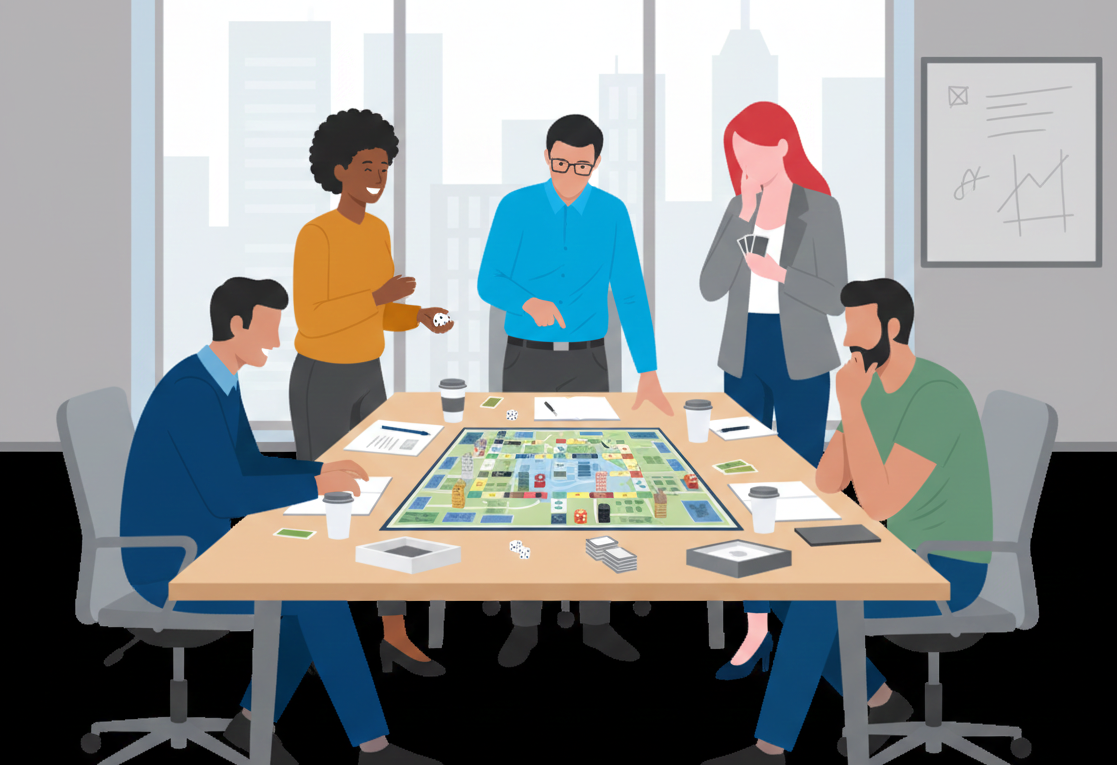
Picture this: Ten adults around a table, making business decisions, arguing over strategy, and having proper “aha moments” about their own behaviour. No PowerPoint. No flip charts. Just a board game.
Sounds like skiving off, doesn’t it? Like someone’s found a clever way to expense their lunch hour at the pub quiz.
Except there’s actual science behind why simulation games can teach you things that stick—and it’s not just because they’re more entertaining than staring at a screen for three hours.
How We Actually Learn Things
Here’s something interesting: remembering information and being able to use it are two completely different skills.
A study from the National Training Laboratories found that whilst we retain about 5-10% of what we read or hear in a lecture, we remember around 75% of what we actually do. That’s the difference between nodding along whilst secretly planning your Tesco order and actually being able to apply something when you need it.
The reason comes down to how our brains work. According to educational researcher Edgar Dale’s “Cone of Experience,” we remember roughly 90% of what we practice or simulate. Our brains file away experiences much more effectively than abstract concepts.
Think about learning to drive. You can read the Highway Code cover to cover, but you don’t really know how to navigate a roundabout until you’ve done it yourself—preferably without your instructor grabbing the wheel in panic.
That’s what simulation games do. They let you practice the mental equivalent of roundabouts without the bit where you might actually crash into a Vauxhall Corsa.
What Makes Simulation Games Different
Simulation games have been used for decades in fields that take learning very seriously. Military strategists use war games to practice tactics. Medical schools use simulated emergencies to train doctors. NASA doesn’t just tell astronauts how to fix a spacecraft—they run them through the scenarios repeatedly until it becomes second nature.
But you don’t need a multi-million-pound setup to get the benefits. A well-designed tabletop game can teach you just as much about decision-making, resource management, and recognising your own habits as any high-tech simulator.
The magic is in how they work.
1. They Mirror Real-World Dynamics
A proper workshop simulation isn’t just a game with a business theme slapped on top. The mechanics need to reflect actual challenges people face.
According to research from MIT’s Sloan School of Management, simulations work best when they create what’s called “cognitive fidelity”—meaning the mental challenges in the game match the mental challenges in real life. It doesn’t need to look realistic; the decisions need to feel realistic.
If you’re learning about client management, you should feel the tension of wanting to win the work without accepting terrible terms. If you’re learning about resource allocation, you should experience the stress of too many demands and not enough capacity.
The game becomes a safe testing ground for real problems.
2. Consequences Happen Immediately
In real life, bad decisions often take months to reveal themselves. Make a dodgy choice in January, and by the time it all goes pear-shaped in June, you’ve forgotten what led to it.
In a game, consequences are immediate. Overcommit your resources? You burn out two rounds later. Ignore warning signs in a client brief? You spin the wheel and discover what “scope creep” actually feels like.
Dr. Karl Kapp, a professor who studies game-based learning, puts it this way: “In games, failure is not stigmatised. It’s expected, and it’s a learning opportunity.”
That’s the crucial bit. People will take risks and make mistakes in a game that they’d never dare make in real life. And they learn from those mistakes without the part where they actually lose money or clients.
3. You See Your Patterns
This is where simulation games get interesting. It’s not really about winning or losing. It’s about recognising why you made the choices you made.
Do you hoard resources because you’re terrified of running out? Do you take on too much work because you’re rubbish at saying no? Do you ignore red flags because you’re desperate?
Those patterns exist in your real business. The game just makes them visible in 90 minutes instead of over three years of costly mistakes.
As psychologist Daniel Kahneman (who won a Nobel Prize for his work on decision-making) notes: “We’re generally overconfident in our opinions and our impressions and judgments.” Games force you to see the gap between what you think you do and what you actually do when decisions get hard.
Why the Group Element Matters
You could, theoretically, play a simulation game on your own. But you’d be missing half the point.
The magic happens when you’re around a table with other people. Here’s why:
You See Multiple Strategies at Once
When you’re the only one playing, you only see your approach. In a group, you see ten different strategies—some brilliant, some baffling, all informative.
You watch someone walk away from an opportunity you would’ve jumped at, and it works out better for them. You see someone take a risk that makes you wince, and it pays off. Or it doesn’t, and you both learn something.
It’s like getting to live ten different versions of the same scenario in one afternoon.
A study in the Journal of Educational Psychology found that collaborative learning—where people work together and observe each other’s approaches—leads to significantly better problem-solving skills than learning alone. You’re not just learning from your own mistakes; you’re learning from everyone else’s too.
You Can’t Hide From Your Patterns
When you’re making decisions in private, it’s easy to justify everything to yourself. “That was the right call given the circumstances.” “Anyone would’ve done the same.” “It was just bad luck.”
But when you’re at a table with nine other people, and they all handled the same situation differently? That’s harder to explain away.
Someone inevitably says, “Why did you take that client? The brief was covered in red flags.” And you have to actually think about it. Because they’re right. And you ignored those same red flags last month with an actual client, didn’t you?
That’s the uncomfortable bit. But uncomfortable is where learning lives.
The Debrief Is Where It Clicks
The game itself is only half the workshop. The real value comes in the conversation afterwards.
“What did you notice about your decision-making?”
“When did you feel most stressed, and what did you do?”
“What patterns showed up that you recognise from your real business?”
That’s when people have revelations. Not because someone told them what to think, but because they saw it themselves. And when you discover something yourself, it sticks.
Educational psychologist Jean Piaget called this “active learning”—the idea that people construct their own understanding through experience and reflection. You can tell someone they’re a people-pleaser who takes on too much work, and they’ll nod politely and ignore you. Let them experience it in a game, and they’ll bring it up themselves in the debrief.
What Makes a Good Simulation Game?
Not all games are created equal. You can’t just grab Monopoly, stick it in a workshop, and call it professional development. (Though Monopoly does teach you that capitalism is exhausting and your family can’t be trusted, which is arguably valuable.)
A proper workshop simulation has a few things in common:
It’s challenging but not overwhelming. If it’s too easy, people get bored. If it’s too complex, they get frustrated and stop learning. The sweet spot is where people feel stretched but capable.
The rules are clear. Nobody learns anything if they’re spending half the game confused about how it works. Good simulations are easy to understand but difficult to master.
It creates genuine tension. You should feel something when you’re playing—stress about running out of resources, pressure to make a decision, frustration when things go wrong. If you’re not feeling anything, your brain won’t bother remembering it.
It’s relevant to real problems. The closer the game mirrors the actual challenges people face, the more likely they are to take the lessons back to their work.
The Business Case (Because Someone Always Asks)
All right, this is lovely in theory, but does it actually work?
The short answer: yes.
A study by the University of Colorado found that students who learned through simulations scored 14% higher on assessments than those who learned through traditional methods. More importantly, they were better able to apply what they’d learned to new situations.
In business contexts, companies like Deloitte, Accenture, and PwC use simulation-based learning extensively for leadership development and change management. Not because it’s trendy, but because it works.
Research published in the Harvard Business Review found that experiential learning methods (including simulations) improved leadership effectiveness by 25% compared to lecture-based training. Participants were better at making decisions under pressure, reading complex situations, and adapting their approach.
And here’s the bit that matters if you’re paying for training: people actually enjoy it, which means they show up, stay engaged, and don’t spend the whole time wishing they were somewhere else.
The Uncomfortable Truth
Here’s the thing nobody tells you about simulation games: they’re not always fun in the moment.
Yes, they’re more engaging than sitting through a presentation. But they’re also more exposing.
When you make a terrible decision in a game and immediately see the consequences, that’s uncomfortable. When everyone else at the table handled the same situation better than you did, that stings a bit. When you realise the pattern that’s sabotaging you in the game is the same pattern running your actual business? That’s not a laugh.
But that discomfort is the point. As author and researcher Brené Brown says: “We can choose courage or we can choose comfort, but we can’t have both.”
The best learning happens right at the edge of your comfort zone. Not so far out that you’re panicking, but far enough that you’re genuinely challenged.
A good simulation game puts you in that spot and keeps you there for 90 minutes. It’s not always pleasant. But it is effective.
Why It Works Better Than You’d Think
At the end of the day, simulation games work because they trick your brain into thinking the stakes are real.
You know it’s just a game. You know the money isn’t real and the clients are fictional. But in the moment—when you’re staring at that decision and trying to figure out what to do—your brain treats it like it matters.
And because your brain thinks it matters, it files the experience away properly. Not in the “interesting but irrelevant” pile where most workshop content ends up, but in the “useful information for next time” pile.
Three months later, when you’re facing a similar decision in your actual business, your brain goes, “Oh, I remember this. Last time we did X, it went badly. Maybe try Y instead.”
That’s the goal. Not to entertain people for 90 minutes (though that’s a nice bonus). But to create experiences that change how people think and make decisions when it actually counts.
Which, when you think about it, is exactly what good training should do—whether it involves a board game or not.
The Bottom Line
Simulation games aren’t a replacement for every type of learning. Sometimes you need information delivered directly. Sometimes you need time to think and reflect. Sometimes you need one-to-one coaching.
But when you need people to understand their own behaviour, recognise patterns, and practice making better decisions? Stick them around a table with a well-designed game, and watch what happens.
They’ll surprise themselves. They’ll surprise you. And they’ll leave with insights they didn’t have two hours ago—not because someone told them, but because they lived it.
And that, really, is the whole point.